
Petrol Ban In India Myth: 1 Truth About Flex-Fuel

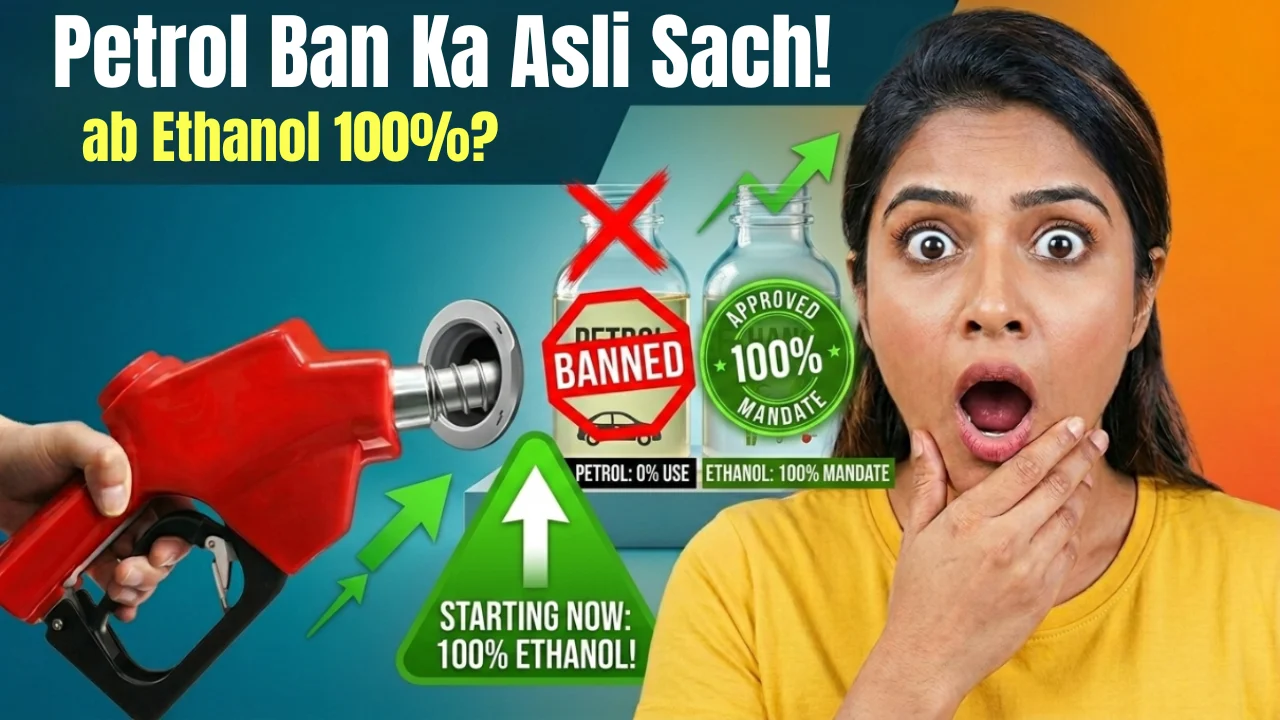
Petrol Ban In India Myth: A rumor is circulating everywhere on social media: is petrol going to be completely banned in India? Many people are hesitant to buy new vehicles out of fear. If you are also confused about this, you have come to the right place. Today, we will get straight to the point without any unnecessary drama. India is currently facing a major fuel crisis, incurring a massive expenditure of approximately ₹22 lakh crore on petroleum imports. To alleviate this burden, the government is introducing 100% ethanol or E100 fuel to the market. Read this article in full to understand how this shift will impact your finances and your vehicle. Petrol Ban In India really?

Petrol Ban In India & Government’s New E100 Policy and the Reality of Engines
To put it simply, ethanol is a type of alcohol-based compound, much like the kind used in hand sanitizers. The government is now producing it from domestic agricultural crops like sugarcane and maize to reduce our dependence on imported oil. However, a major issue and concern arises here: if you were to pour 100% ethanol directly into a standard petrol engine, the vehicle wouldn’t just fail to run—its engine would be completely ruined. Ethanol causes the rubber and metal components inside conventional engines to corrode. Therefore, using this fuel requires a completely different type of engine, known as a Flex-Fuel Vehicle (FFV).
Traditional Petrol vs E100 Fuel
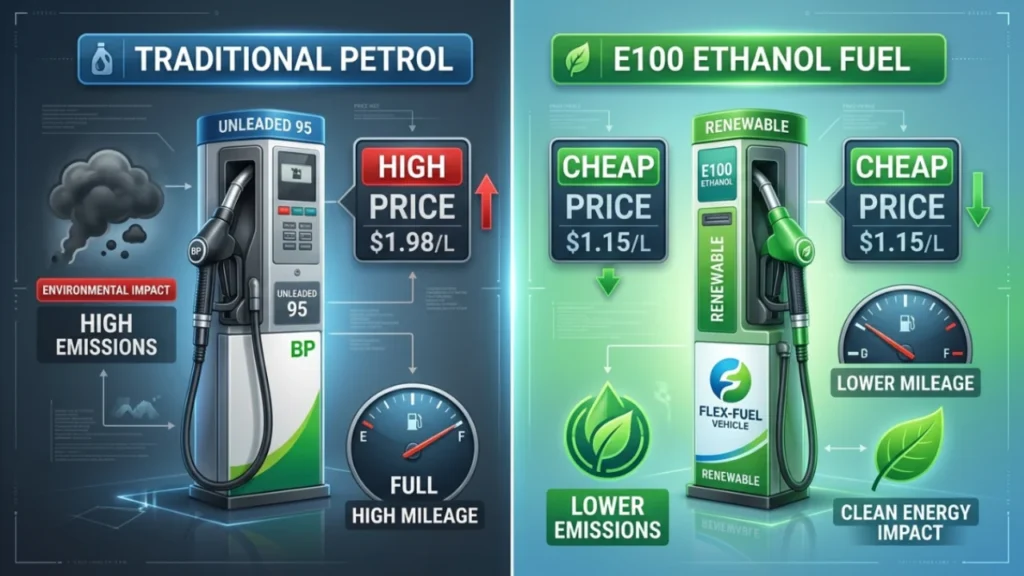
| Feature | Traditional Petrol | E100 Ethanol Fuel |
|---|---|---|
| Engine Compatibility | Standard Petrol Engines | Flex-Fuel Vehicles (FFVs) Only |
| Price Per Liter | High (Imported Material) | Cheap (Produced Domestically) |
| Energy Density | High (Gives Better Mileage) | Low (Gives ~50% Less Mileage) |
| Engine Damage Risk | Zero for Normal Cars | Severe Damage to Non-FFV Cars |
| Environmental Impact | High Carbon Emissions | Cleaner, Renewable Option |

Rise of Flex-Fuel Vehicles in the Indian Market
You might be wondering: if this fuel cannot be used in standard engines, what will people do with it? To address this, major automobile companies in the country have started manufacturing Flex-Fuel Vehicles (FFVs).
- Maruti Suzuki has already showcased a flex-fuel prototype of its Wagon R, capable of running smoothly on both petrol and E100 fuel.
- In the two-wheeler segment, major brands like Hero Motors and TVS are rapidly developing ethanol-compatible bikes and scooters.
- Hyundai, Toyota, and MG Motors are also set to introduce this flex-fuel technology in their premium vehicle lineups soon.
- The key point to understand here is that traditional petrol engines are not being discontinued; instead, a new, parallel fuel option is being introduced to the market to provide customers with a choice.
Why is the Ethanol and Flex-Fuel Trend Catching Fire?
- A ₹22 Lakh Crore Burden: A massive chunk of India’s foreign exchange reserves is spent on petroleum imports, placing significant strain and pressure on the economy.
- Farmers’ Earnings: Ethanol is produced entirely from sugarcane and maize, providing our local farmers with a new and sustainable source of income.
- Pollution Control: Compared to fossil fuels, ethanol emits significantly less carbon, which will help improve the poor air quality in our cities.
- Transition Target: This technology serves as an ideal interim solution until the Electric Vehicle (EV) ecosystem across India becomes fully affordable and stable.
- Support from Auto Giants: Major brands—ranging from Maruti to Toyota—are investing in this sector, which is the strongest proof of its potential success.
| EV vs Petrol Cost Calculator | Click Here |
| EV EMI Calculator 2026 | Click Here |
| Compare EV Loan 2026 | Compare Now |
| EV Subsidy Portal | Compare Now |
CONCLUSION
So, the bottom line is that the fear of petrol being banned is completely baseless. The government’s aim is not to discontinue petrol but to develop an affordable, indigenous alternative in the form of ethanol. If you are planning to buy a new vehicle soon, you can go ahead and purchase a petrol car without any worry, or you could wait a while and opt for the upcoming flex-fuel vehicles. Looking at the long term, the future belongs entirely to Electric Vehicles (EVs); until then, ethanol will help sustain our economy. What do you think—will flex-fuel vehicles succeed? Instead of falling for false rumors, please share accurate information.